
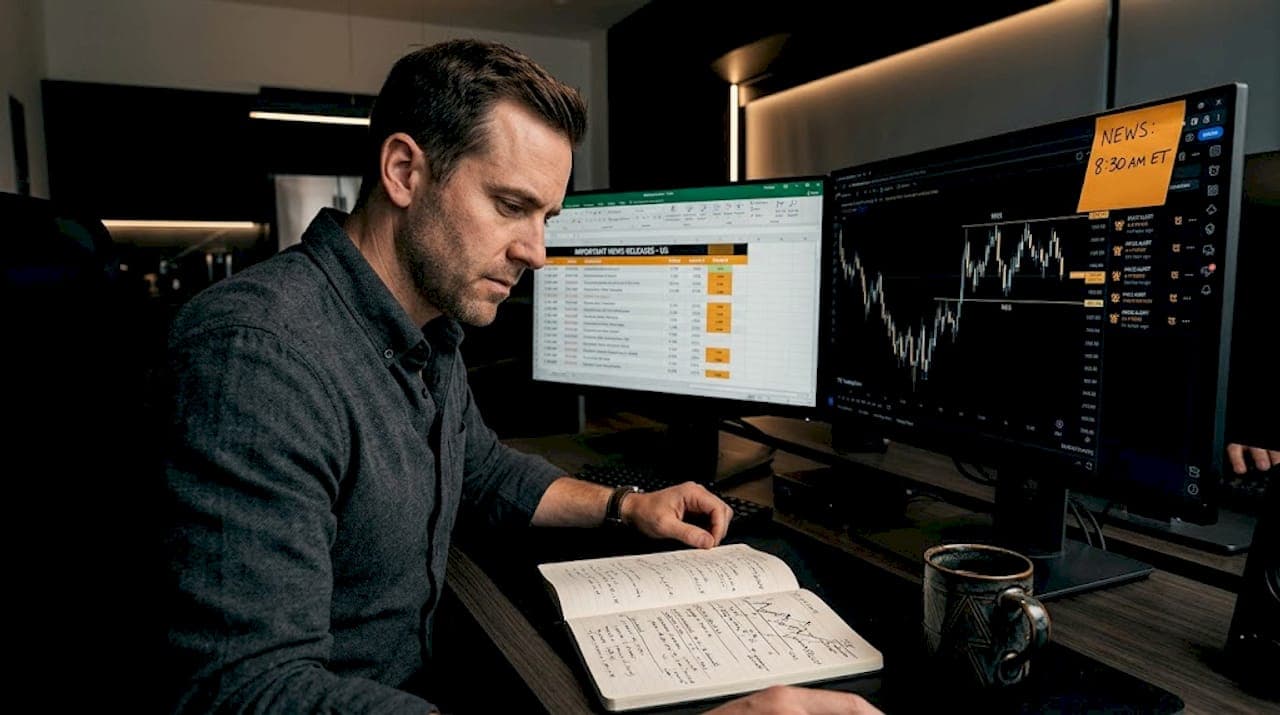
News events are where fortunes shift fast in futures markets. Whether you're watching the Non-Farm Payrolls drop at 8:30 AM or reacting to an unscheduled geopolitical headline, the opportunity to trade around news events in futures is real and measurable. But so is the risk. Most traders get hurt not because the move went against them, but because they were unprepared for the speed, the fakeouts, and the compliance pitfalls that come with event-driven trading. This guide covers preparation, execution, instrument-specific strategy, and risk management so you can approach these moments with a clear plan.
Table of Contents
- Key Takeaways
- How to trade around news events futures: preparation first
- Executing trades around news releases
- Comparing strategies across different news events
- Common mistakes and risk management
- Reviewing trades to build a real edge
- My take on trading futures around news events
- Trade smarter with Instantfuturestrading
- FAQ
Key Takeaways
| Point | Details |
|---|---|
| Volatility is the signal | Macro news transmits through volatility spikes, not sustained trends, so size and manage trades accordingly. |
| Instruments react differently | RTY moves more than twice as much as ES on NFP days, requiring tailored strategy by instrument. |
| Fakeouts are the norm | Over 71% of NQ NFP days show a counter-wick larger than 5 points immediately after release. |
| Compliance matters | Trading on material nonpublic information obtained through a breach of duty is illegal under CFTC Rule 180.1. |
| Post-trade review drives improvement | Tracking entry and exit timing relative to the news release is the fastest way to refine your edge. |
How to trade around news events futures: preparation first
The industry term for this practice is event-driven trading, and it covers any strategy that positions around scheduled or unscheduled market-moving information. Knowing what is coming and when is your starting point.
Build your event calendar around these high-impact releases:
- Non-Farm Payrolls (NFP): First Friday of each month, 8:30 AM ET
- Consumer Price Index (CPI): Monthly, 8:30 AM ET
- FOMC rate decisions: Eight times per year, 2:00 PM ET
- GDP releases, retail sales, and ISM manufacturing data
- Unscheduled events: geopolitical headlines, Fed speeches, earnings surprises
Use tools like the CME Group economic calendar, Investing.com, or your broker's integrated calendar. Cross-reference expected versus prior readings so you understand the consensus. When actual data deviates significantly from consensus, that is when the largest moves occur.
Understanding instrument-specific reactions is non-negotiable. NFP data across 69 trading days shows that RTY (Russell 2000 futures) posts a median 30-minute move of 0.65%, while ES (S&P 500 futures) moves only 0.28% in the same window. If you trade RTY with the same position size you use on ES during news events, you are taking on more than twice the volatility risk without realizing it.
Set up your trading platform before the event. Pre-load your charts, set price alerts at key levels, and confirm your order entry shortcuts are working. Execution speed matters. Order flow spikes sharply in the minutes surrounding major releases, and slow execution will cost you fills.
On the compliance side: you are legally permitted to trade futures based on public information and your own analysis. What is prohibited is trading on material nonpublic information (MNPI) obtained through a breach of a duty or trust relationship. CFTC Rule 180.1 targets misappropriation, not all pre-announcement activity. Review your trading rules and risk framework to confirm you are operating within lawful boundaries.
Pro Tip: Set a hard rule: no new positions within 60 seconds before a scheduled release unless you have a defined pre-event strategy. Chasing in the final seconds before a print is one of the most common and costly mistakes in news trading.
Executing trades around news releases
Execution is where preparation either pays off or falls apart. The steps below apply to scheduled macro events, though the principles carry over to unscheduled headlines.
-
Pre-event analysis (30 to 60 minutes before release). Identify the prior reading, consensus estimate, and the range of surprise scenarios. Mark key support and resistance levels on your chart. Decide in advance: will you trade the initial spike, wait for confirmation, or use a mean reversion approach after the dust settles?
-
Choose your entry approach. There are two primary techniques used by experienced futures traders:
- Breakout or momentum entry: Enter in the direction of the initial move once price clears a defined level. This works best when the data surprise is significant and one-directional.
- Mean reversion entry: Wait for the initial spike to exhaust and fade back toward a value area. Combining mean reversion models with volatility-stretch signals has produced some of the most consistent risk-adjusted returns in index futures over multi-decade backtests.
-
Manage the fakeout window. The first 30 to 90 seconds after a release are the most dangerous. 71% of NQ NFP days show a counter-wick larger than 5 points immediately after the print. Do not commit full size during this window. Use a partial entry, confirm the move is holding, then add.
-
Set volatility-adjusted stops. Do not use your standard dollar-risk stop during a news event. Macro news transmits primarily through volatility spikes, not sustained directional moves. A stop that is too tight will get hit by noise before the real move develops.
-
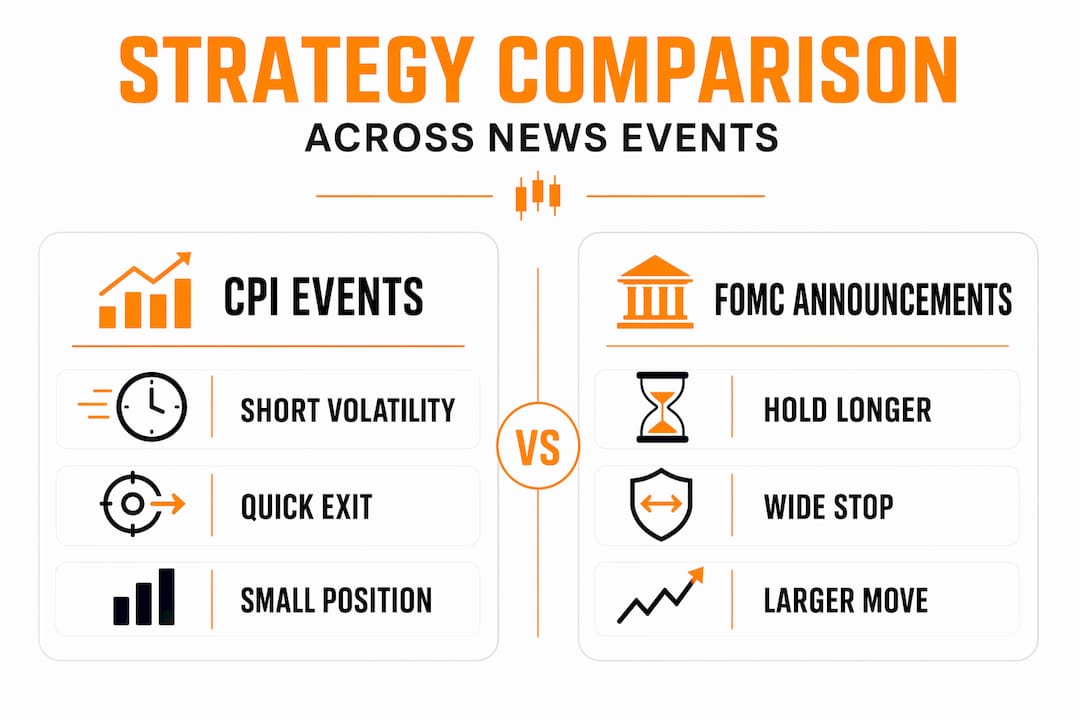
Define your exit before entry. Know your target and your maximum hold time. CPI and NFP events produce short-lived volatility spikes, while FOMC decisions tend to have more persistent effects. Adjust your trade duration accordingly.
-
Post-release review. Log your entry time, exit time, slippage, and whether you captured the volatility move or fought it. This data compounds into a real edge over time.
Pro Tip: Use volatility as your primary signal, not price direction. If implied volatility contracts sharply after a release, the market is digesting the news. That compression often precedes the real directional move.
Comparing strategies across different news events

Not all news events behave the same, and not all futures instruments respond the same way to identical data surprises. This is where most traders leave money on the table.
| Event Type | Best Instruments | Typical Volatility Duration | Preferred Strategy |
|---|---|---|---|
| NFP | RTY, NQ, ES | 15 to 45 minutes | Breakout with fakeout filter |
| CPI | NQ, ES, GC (Gold) | 10 to 30 minutes | Mean reversion after spike |
| FOMC | ES, NQ, YM | 60 to 180 minutes | Momentum with wide stops |
| Geopolitical headline | CL (Crude Oil), GC | Highly variable | Reactive, reduced size |
| GDP / Retail Sales | ES, YM | 10 to 20 minutes | Mean reversion |
Key behavioral differences by instrument:
- RTY vs. ES: RTY peaks faster and moves farther on NFP days. RTY peaks at a median of 135 minutes post-release, while NQ takes 270 minutes to peak. If you want a fast in-and-out trade, RTY gives you more movement in a shorter window.
- NQ vs. ES: NQ is more sensitive to rate expectations, making it the preferred instrument around FOMC decisions. ES is more balanced and tends to be the cleaner mean reversion candidate.
- Gold (GC) and crude oil (CL): These react strongly to geopolitical surprises and inflation data. The BBC's reporting on the March 2026 Trump-Iran situation showed oil futures volume surging 15 minutes before the announcement, with oil dropping 14% shortly after. Unscheduled events in these instruments carry extreme liquidity risk.
The key takeaway here is that instrument-specific reaction timing determines how long you should hold and how wide your stops need to be. A one-size-fits-all approach to news trading will underperform a tailored one every time.
Common mistakes and risk management
Even traders with solid preparation make costly errors during live news events. These are the ones that show up repeatedly.
Mistakes that consistently hurt traders:
- Trading on rumor or hype: Positioning based on pre-release speculation rather than actual data is one of the fastest ways to get caught on the wrong side of a surprise.
- Ignoring fakeouts: The initial direction of a move in the first 30 seconds is wrong more often than most traders expect. Waiting for confirmation is not weakness. It is discipline.
- Fixed position sizing: Using the same contract size regardless of event type ignores the fact that volatility-based sizing is the correct approach around macro announcements. Reduce size before the release, not after you are already underwater.
- Misusing information: Trading on MNPI obtained through a professional relationship is a CFTC enforcement target. The line is not about knowing something others do not. It is about how you obtained that information and whether a duty was breached.
"The biggest losses in news trading come not from bad analysis, but from good analysis executed with bad timing and wrong position size."
Pro Tip: Before any high-impact release, write down your maximum acceptable loss for that trade. If you cannot define it before the event, you are not ready to trade it.
Mental discipline is also part of risk management. High-impact events create adrenaline. That adrenaline leads to oversizing, revenge trading after a fakeout, and holding losers past your stop. Build a pre-event checklist and follow it regardless of how confident you feel about the outcome.
Reviewing trades to build a real edge
Post-trade analysis is where news trading strategies actually improve. Without it, you are repeating the same mistakes in different market conditions.
Track these metrics for every news-event trade:
- Entry time relative to the news release (before, at release, or confirmed)
- Exit time and whether you captured the volatility spike or held through the reversal
- Slippage versus expected fill price
- Whether the initial move direction matched your entry direction
- Volatility capture: did you get the range, or just a fraction of it?
After 20 to 30 trades, patterns will emerge. You will see which instruments you execute best on, which event types produce consistent results for your approach, and where your timing consistently breaks down. Adjust your preparation process based on this data. If you consistently get faked out on NFP, shift to a confirmation-based entry and test whether your results improve over the next 10 trades.
The goal is not perfection. It is a measurable, repeatable process that gets better with each review cycle.
My take on trading futures around news events
I've watched traders approach news events with the same strategy they use for normal market hours, and it almost never works. The assumption that a strong data print means a sustained directional move is wrong more often than it is right. What I've found is that the first 60 seconds after a release are mostly noise. The real opportunity is in the 5 to 15 minutes that follow, once the fakeout has played out and actual order flow establishes direction.
What surprises most traders is how much instrument choice matters. I've seen traders frustrated with their NFP results on ES switch to RTY and immediately see more movement to work with, simply because RTY responds with greater magnitude to the same data. That is not luck. It is understanding the mechanics of what you are trading.
The legal side is something I take seriously and think most traders underestimate. The CFTC's first insider-trading enforcement action in 2026 was a clear signal that regulators are watching event-driven futures activity more closely. You do not need to be doing anything obviously wrong to end up in a gray area. Know where your information comes from and how it was obtained.
Finally, the psychological pressure of news events is real. The best traders I've observed treat these moments like a surgeon treats an operation: calm, prepared, and completely committed to the process they designed before the pressure started.
— Amos
Trade smarter with Instantfuturestrading
If you are serious about improving your performance around high-impact news events, having the right trading infrastructure matters as much as strategy.
Instantfuturestrading gives you instant funded accounts from $5K to $300K with no evaluation phase and no challenge to pass. You get real-time CME market data across 40+ instruments on the Rithmic platform, including full access to gold (GC), crude oil, and all major index futures. US traders can access funded accounts starting from $39, while UK and Australian traders can explore dedicated account options at Instantfuturestrading UK and Instantfuturestrading AU. With a 90% profit split, no trailing drawdown, and the ability to stack up to 20 accounts simultaneously, you have the capital flexibility to execute news-event strategies at scale.
FAQ
What futures instruments move the most on NFP?
RTY (Russell 2000 futures) shows a median 30-minute move of 0.65% on NFP days, more than double the 0.28% move seen in ES. RTY is the highest-movement instrument for this specific event.
Is it legal to trade futures before a news announcement?
Yes. Trading futures before a scheduled announcement based on your own analysis and public information is legal. What is prohibited is trading on material nonpublic information obtained through a breach of a duty or trust relationship under CFTC Rule 180.1.
What is the biggest mistake traders make during news events?
The most common error is entering at the initial spike without accounting for fakeouts. Over 71% of NQ NFP days produce a counter-wick larger than 5 points immediately after release, meaning the first move is frequently reversed before the real direction establishes.
How long do volatility spikes last after major news releases?
CPI and NFP events typically produce short-lived volatility spikes lasting 10 to 45 minutes. FOMC decisions create more persistent effects that can last 60 to 180 minutes, requiring wider stops and longer trade durations.
Should I use the same position size during news events as normal trading?
No. Volatility during news events is significantly higher than during normal sessions. Reduce your position size before the release and scale in only after the initial fakeout window has passed and direction is confirmed.